|
Stages in Developing Handwriting
© Beverley Paine
[an excerpt from Developing Children's Handwriting, a Practical Homeschooling Booklet, by Beverley Paine, available from Always Learning Books.]
Children learn to write because they see adults and other children writing, and they see it as a natural part of growing up. Providing children with examples of people writing for a variety of authentic purposes is essential to encourage learning to write.
All children progress through the following stages. In each stage children are building a series of ‘rules’ based on experimentation. This process involves hypothesis formulation and testing, in which attempts are made, reviewed and revised. Progressing through these stages may take some children several years.
1. The scribble stage.
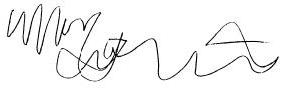
The child has hypothesized that it is possible to send messages to someone else by putting squiggly marks on paper. The starting point may be anywhere on the page.
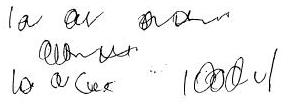
In the above example, the line is continuous, but the child has started at the side of the page and moved from left to right across it. He has also hypothesized that when writing a message he needs to start at the left hand side of the paper and proceed straight across.
2. Personal or non-conventional symbols.
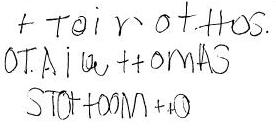
Here the child separates the squiggles or non-conventional symbols and obeys the directional features of our written language. The child has recognised that writing moves from left to right across the page, and is a collection of separate symbols.
3. Strings of conventional symbols.
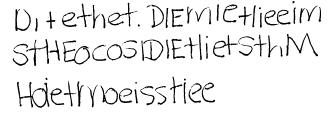
Here the child strings together many letters from the alphabet and moves from left to right across the page and progressively down. The child has hypothesized that when people write they use a particular set of symbols which are repeated over and over again and are not invented.
4. Groups of letters with spaces between each group.
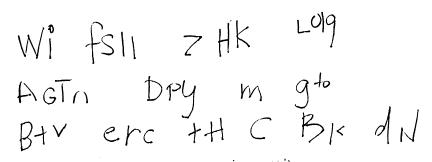
Here there is no match between the letters and the sounds of the words, but the child has some concept of a word. At this stage it is appropriate for you to write for the child what he or she says has been written, and to encourage invented spellings and approximations.
5. Writing where the child reveals developing awareness of sound-symbol correspondences.
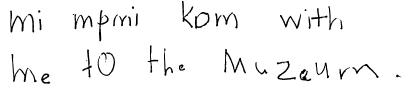
At this stage any person who is literate in English is able to work out and read back what the child has written.
6. Gradual inclusion of writing conventions, uniform size and direction of letters, uniform writing style, correct use of capitalisation, etc.
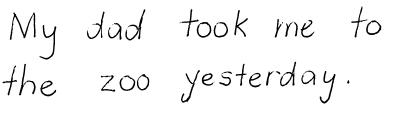
The child is able to write, generally in a print style, following most of the conventions of writing. Letter positioning on lines, and uniformity in size is apparent. The child’s writing is able to be easily read.
7. Development of cursive writing style.
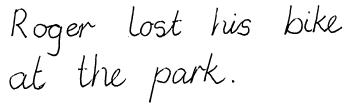
Here the child has been shown how to write using a cursive style, and the writing conforms to a modern style. Attention to slant, formation of letters, and legibility is apparent.
Cursive writing provides your children with a fast, efficient and legible writing style. It is worth encouraging, and a suitable time to begin training your children to write using cursive is when they are comfortable with the writing process in general. Many children show an interest in emulating the cursive style of adults and will ask to be shown how to write in this way.
Cursive is joined script. Emphasis needs to be placed on the formation of letters, beginning, ending and connection strokes, slant, reducing the size of letters and increasing speed. To help your children develop a neat slant you can make ‘slant reminder’ sheets to place under their pages as they write.
It isn’t necessary to schedule separate cursive handwriting lessons - encourage your children to practice their cursive skills during any writing activity they do. Gently point out where improvements can be made and praise all efforts. Some children will never choose to learn to write cursive, and others may prefer to develop typing and keyboarding
skills instead.
The important thing to remember throughout is that handwriting is only one way of being able to express the written word, and that the reason for writing is to be able to communicate with others for the sake of meaning, not neatness!

Was this article helpful? Was it worth $1.00 to you?
Your gift of $1 or more helps to keep this site operating
offering encouragement
and reassurance to families
wanting
better outcomes for their children.
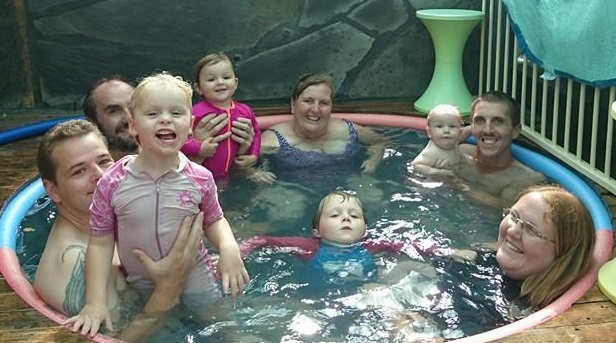
Beverley Paine with her children, and their home educated children, relaxing at home.
Together with the support of my family, my aim is to help parents educate their children in stress-free, nurturing environments. In addition to building and maintaing this website, I continue to create and manage local and national home educating networks, help to organise conferences and camps, as well as write for, edit and produce newsletters, resource directories and magazines. I am an active supporter of national, state, regional and local home education groups.
"You've been an inspiration to me, I love the way
you really listen to people." Vanessa
"Whenever I read your writing I always come away
with increased confidence in my ability to provide and
share a wonderful learning journey with my family!" Davina
"Your guidance, understanding, support and words of
wisdom changed our lives. We now offer support and
organise many homeschooling events for others." Lesley
"Thank you once again for your prompt and friendly service.
I am convinced that your books are going to add
quality and peace of mind to my journey of teaching my kids
at home! Just from studying your website, until almost
2am
in the morning, I 've been encouraged!" Louisa
"Thank you for all your many,many reassuring words
over many, many years. You probably don't know exactly how
valuable you are to the Australian Home Education community.
I've been reading your stuff for maybe 8 years or more now.
And I'm very grateful." Gythaa


Want to learn how to write your own education plans
to suit your unique children's individual learning needs?
Or you are looking for quality curriculum and teaching tips...
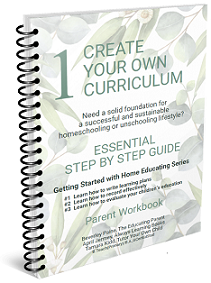
Comprehensive 3 workbook 'how to home ed' course
covering the essential skills you need
successfully home educate your children
|
Welcome to the World of Home Education
and Learning without School!
We began educating our children in 1985, when our eldest was five. In truth, we had helped them learn what they need to learn since they were born. I am a passionate advocate of allowing children to learn unhindered by unnecessary stress and competition, meeting developmental needs in ways that suit their individual learning styles and preferences. Ours was a homeschooling, unschooling and natural learning family! There are hundreds of articles on this site to help you build confidence as a home educating family. We hope that your home educating adventure is as satisfying as ours was! Beverley Paine
3 ESSENTIAL STEP BY STEP GUIDES
Let experienced home educators Beverley, Tamara and April walk you through HOW to create a learning plan that builds on solid foundations that works for YOUR family AND ticks all the boxes for home educaton registration!
|
Tap into Beverley's
experience
through her books
"Your books, your blogs helped me beyond words... they helped me to find comfort in knowing it is ok to choose exactly what is best for my family." Nisha
"Your books and information are mind blowing and already I am feeling good about this new experience." Diane
"Your guidance, understanding, support & words of wisdom changed our lives." Leslie
"I feel specially inspired by Beverley's words and, the more I read her comments, the more inspired I feel, since my need for support, respect for different parenting styles, and information are fully met." Marijo
|
 |
|

The information on this website is of a general nature only and is not intended as personal or professional advice. This site merges and incorporates 'Homeschool Australia' and 'Unschool Australia'.
The Educating Parent acknowledges the Traditional Aboriginal and Torres Strait Islander Owners, the Custodians of Australia, and pay our respects to Elders past and present and extend that respect to Aboriginal and Torres Strait Islander people viewing this website.
Advertise on this site.





Home education is a legal alternative
to school education in Australia.
State and Territory governments are responsible
for regulating home education and have different
requirements, however home educating families
are able to develop curriculum and learning programs
to suit the individual needs of their children.

Without revenue from advertising
by educational suppliers and Google Ads
we could not continue to provide information
to home educators. Please support us by letting
our advertisers know that you found them on
The Educating Parent. Thanks!
|
 About
About
 Thank you for visiting!